The formation of top-shaped asteroids
Finding the basic mechanism governing the surface history of asteroids of various shapes is essential for understanding their origin and evolution. In particular, the currently visited asteroids (162173) Ryugu and (101955) Bennu by Hayabusa2 and OSIRIS-REx appear to be top-shaped. This distinctive shape, characterized by a raised equatorial bulge, is shared by other similarly sized asteroids, including Didymos A, 2008 EV5, 1999 KW4 Alpha and 1994 CC. However, the possibly common formation mechanism that causes the top-like shape is still under debate. One clue may lie in the boulders on their surfaces! The distribution of these boulders, that was precisely measured in unprecedented detail by the two spacecrafts, constitutes a record of the geological evolution of the surface regolith since the origin of these asteroids.
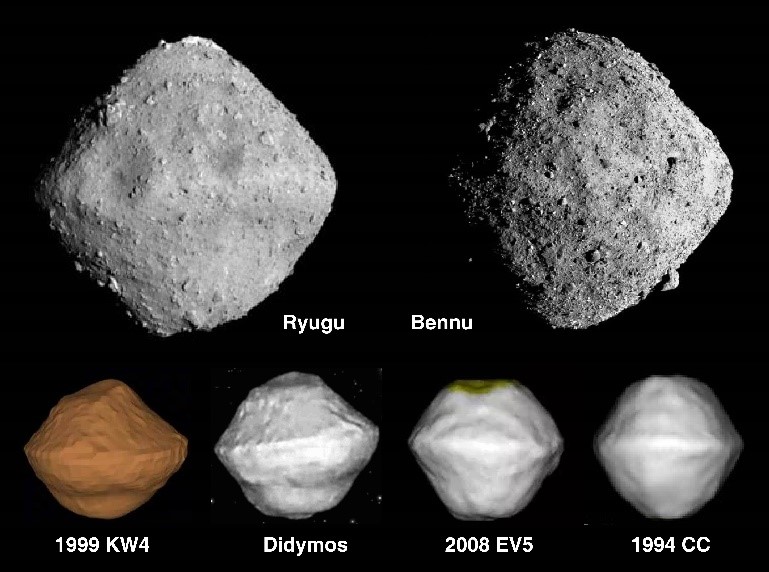
Top-shaped asteroid family found in our Solar System.¶ |
Here, by DEM simulations using DEMBody, we show that during the regolith migration driven by YORP spin-up, the surface boulders co-evolve with the underlying regolith and exhibit diverse dynamical behaviors: they can remain undisturbed, sink into the regolith layer and become tilted, or totally be buried by the downslope deposition, depending on their latitudes. The predominant geological features commonly observed on top-shaped asteroids, including the boulder-rich region near the pole, the deficiency of large boulders at the equatorial area and partially buried, oblique boulders exposed on the regolith surface, are commensurate with this coevolution scenario. The surface regolith migration thus is the prevalent mechanism for the formation history of the top-shaped asteroids with stiffer cores.
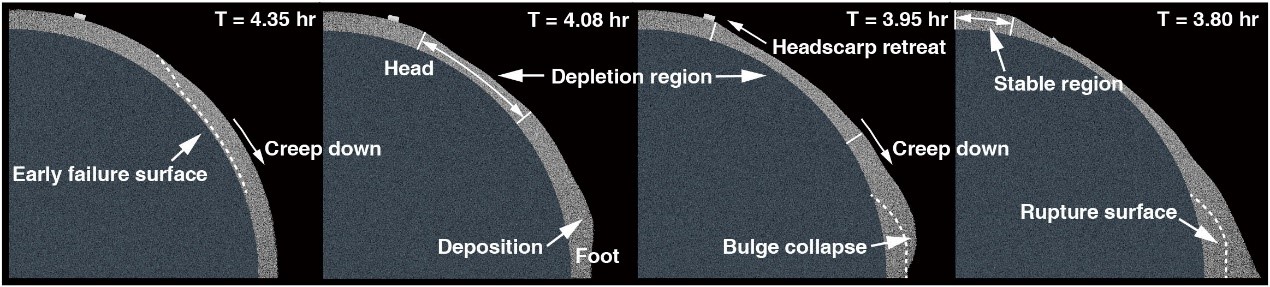
Evolution of the regolith and boulder under the YORP effect.¶ |
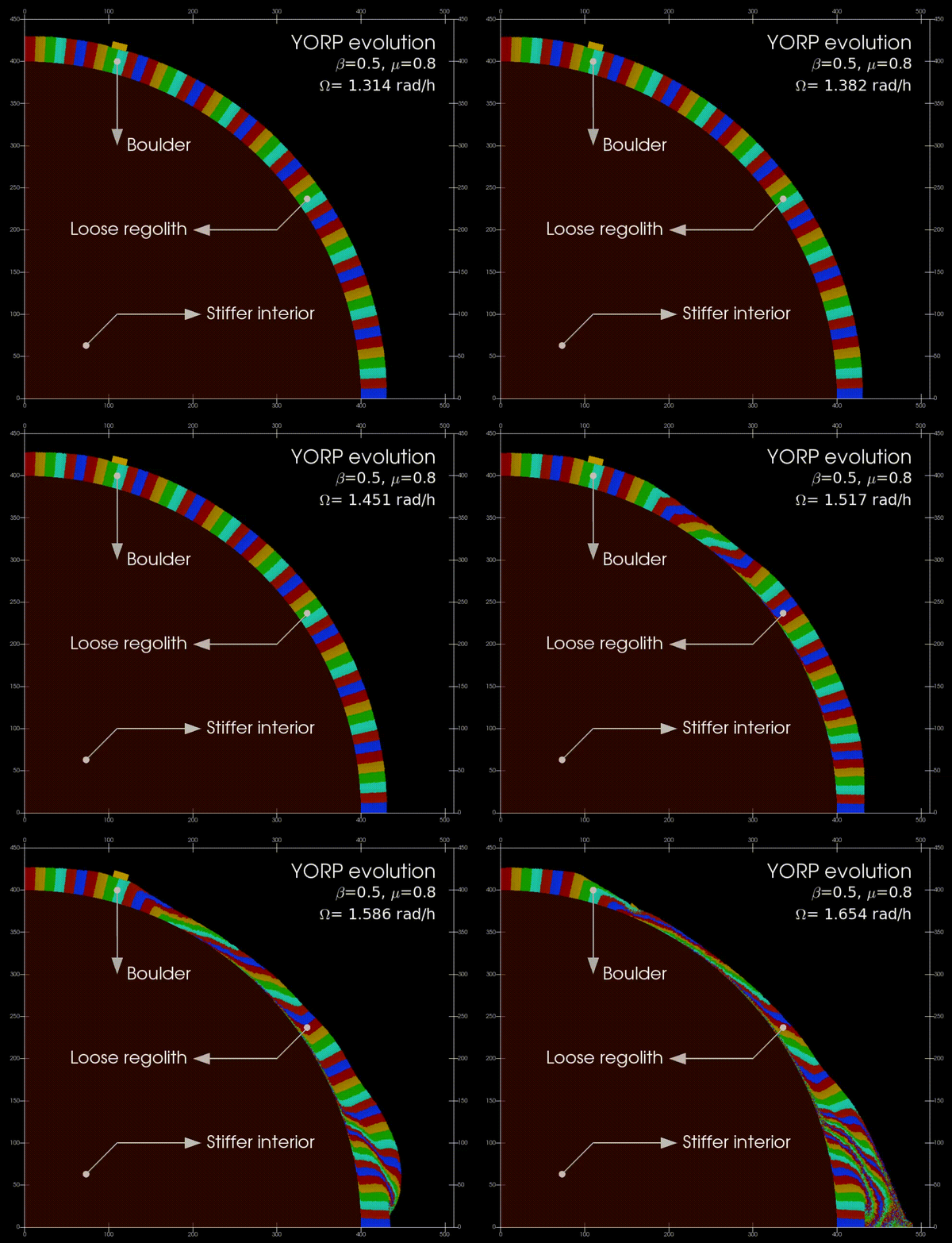
Boulders at high latitudes sink into the regolith layer and become tilted.¶ |
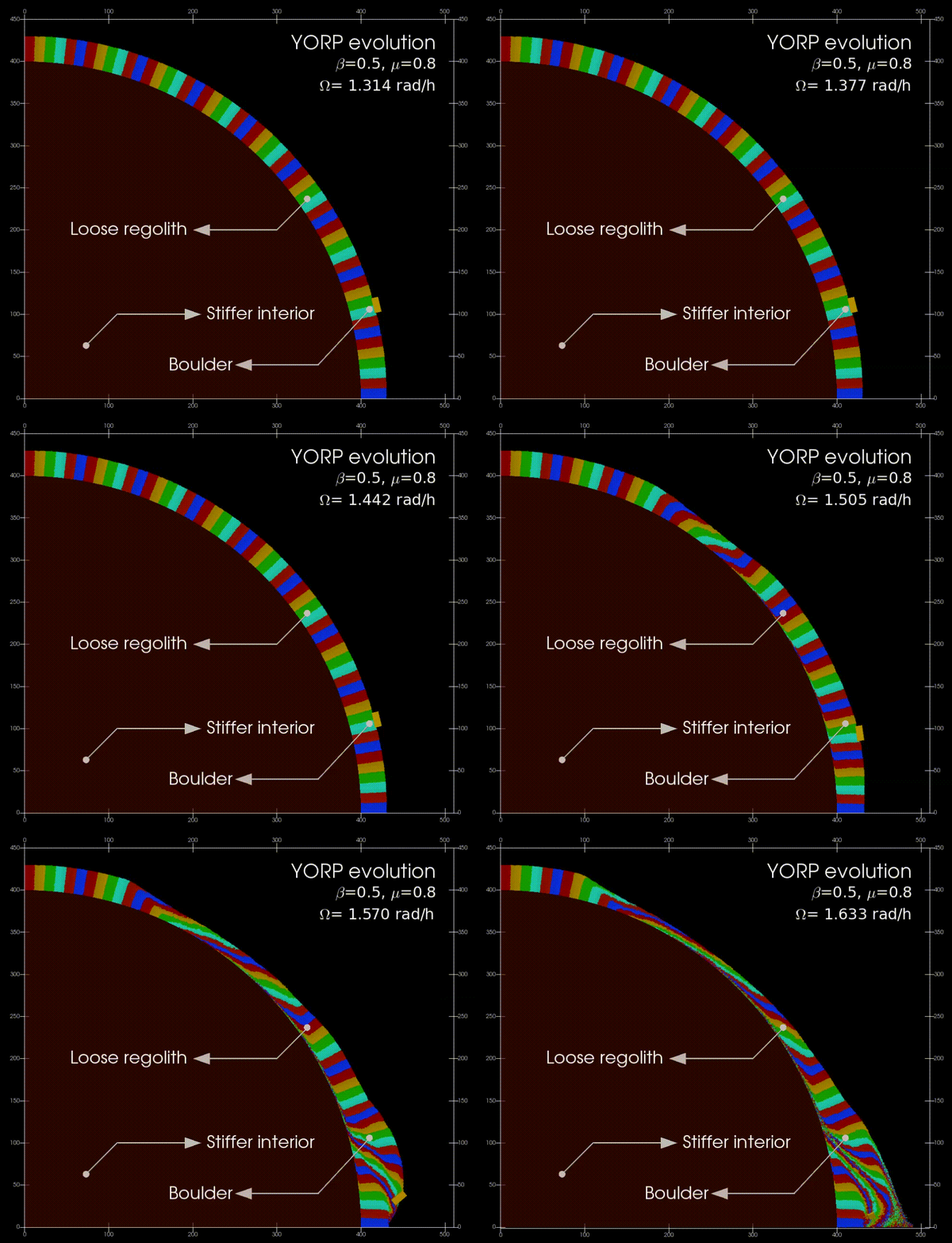
Boulders near the equator are totally buried by the migration debris.¶ |
Related paper: Cheng, B., Yu, Y., Asphaug, E., Michel, P., Richardson, D. C., Hirabayashi, M., Yoshikawa, M., & Baoyin, H. Reconstructing the formation history of top-shaped asteroids from the surface boulder distribution, Nature Astronomy, 2020, https://doi.org/10.1038/s41550-020-01226-7