Small body regolith penetrator
Small airless bodies of the Solar System are known to be covered in a layer of loose unconsolidated soil, composed of grains ranging from dusty sands to rugged gravels. As a result of the fluid-solid-like dual nature of granular materials under low-gravity environment, varied geophysical processes have modified and altered the regolith beds since their origin. The landforms on the regolith-blanketed surfaces, therefore, hold vital clues to reconstructing past processes occurring on small bodies and then to deciphering their formation histories. However, the mechanical strength of regolith remain unclear, which is an important parameter for understanding its dynamical evolution. Furthermore, mechanical properties are also one of the key factors for the design and operation of any space missions planned to interact with small body surfaces. Granular penetrator, an instrument that allows for in-situ mechanical characterization of surface/subsurface materials, has attracted considerable attention. However, we still do not fully understand the penetrating dynamics related to granular regolith, partly due to the experimental difficulties in measurement of the three-dimensional grain-scale responses under micro-gravity.
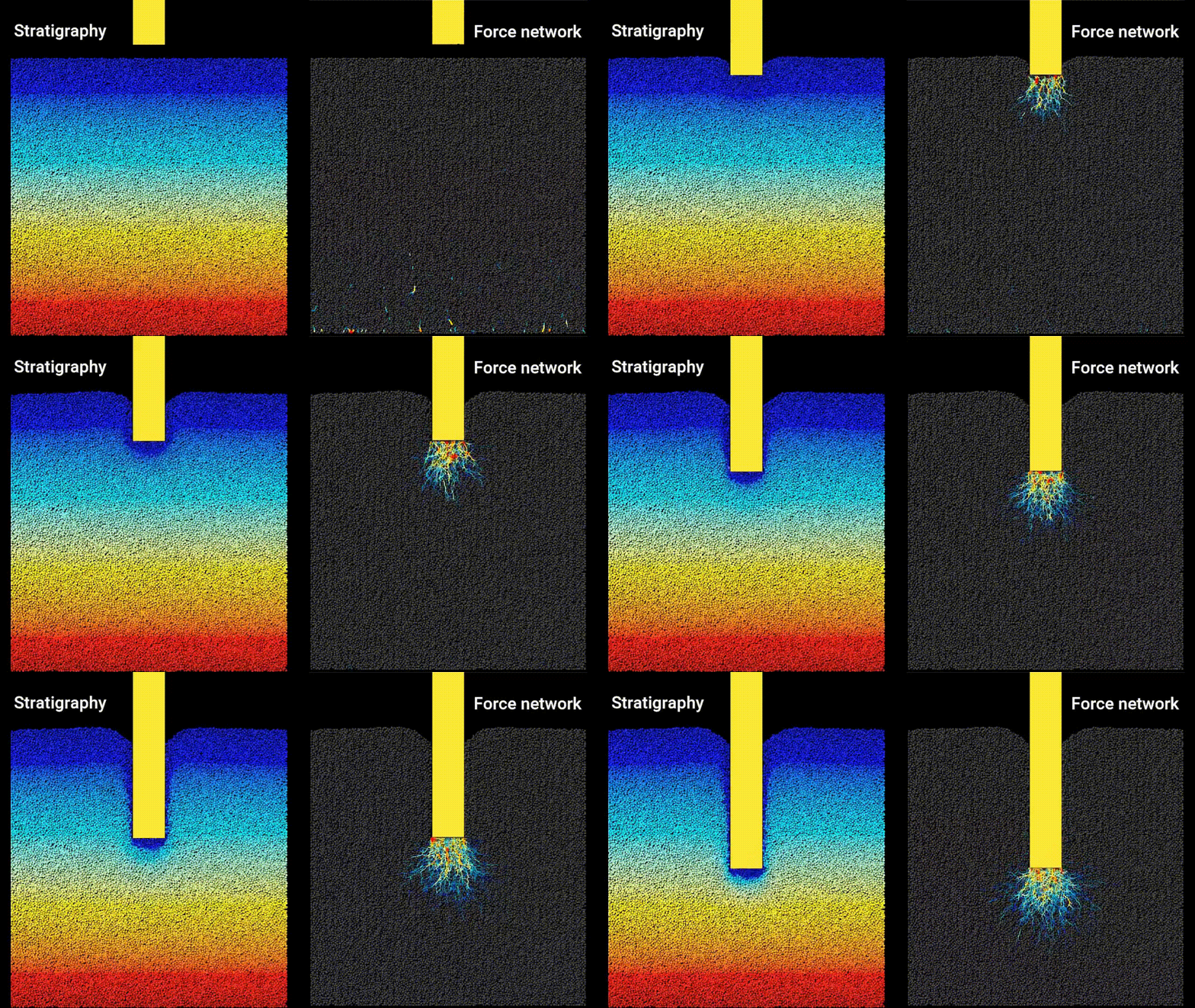
Stagnant zone and force chains formed in front of the penetrator tip.¶ |
In this paper, we study the slow intrusion of solid locomotors into granular matter on small bodies by large-scale numerical simulations based on the Soft-Sphere Discrete Element Method. We show that the resistance force increases abruptly with the penetration depth after the contact and then transits to a linear regime. The scale factor of the steady-state part is roughly proportional to the internal friction of cohesion-less granular materials, which in turn allows us to deduce the shear strength of planetary soils by measuring the force–depth relation. Such an observation could be explained by a physics-based model incorporating the buckling failure of obstructive force chains. When cohesion is included, due to the brittle behavior of cohesive materials, the resistance profile is characterized by a stationary state at large penetration depth. The saturation resistance, which represents the failure threshold of granular materials, increases with the cohesion strength of the regolith.
Related paper: Cheng, B., Asphaug, E., Schwartz, S., & Baoyin, H. Measuring regolith properties of small bodies using granular penetrators, under review