Tidal disruption as the origin of Phobos grooves
The long, shallow, parallel grooves that cut across the surface of the Martian moon Phobos remain enigmatic, with distinct implications for understanding the properties and evolution of loose airless soils and the origin of Mars and its satellites. Phobos orbits deep inside the Roche limit and is gradually spiraling in, creating global tidal strain, which leads to the possibility that orbital decay is driving global surface deformation.
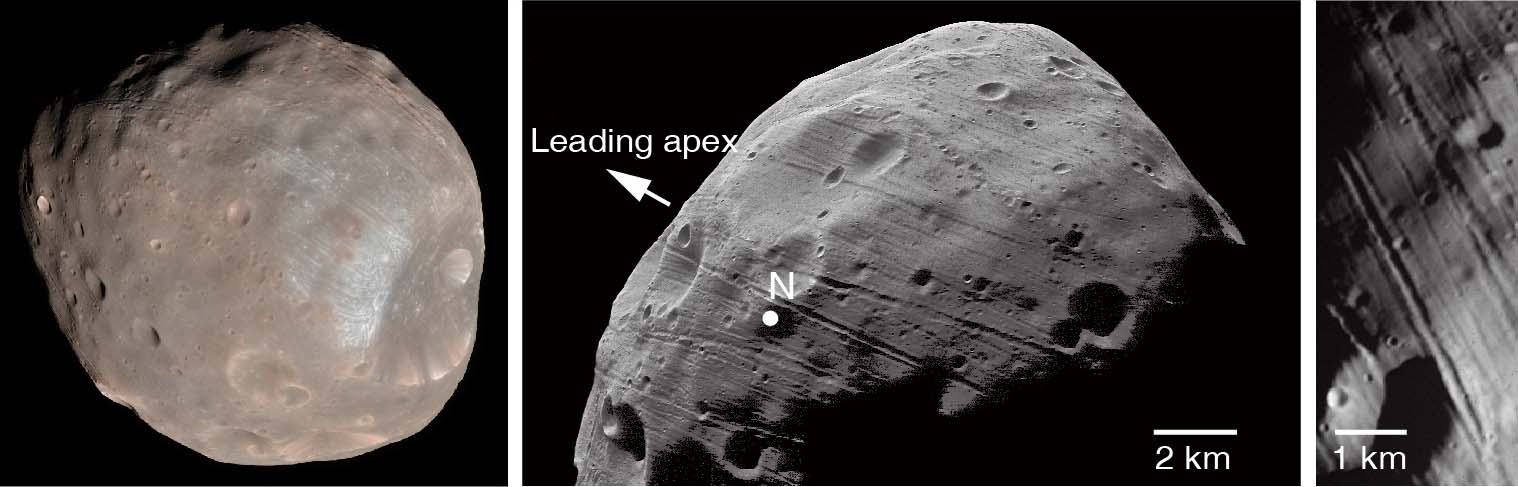
Linear depressions cutting across Phobos’s surface.¶ |
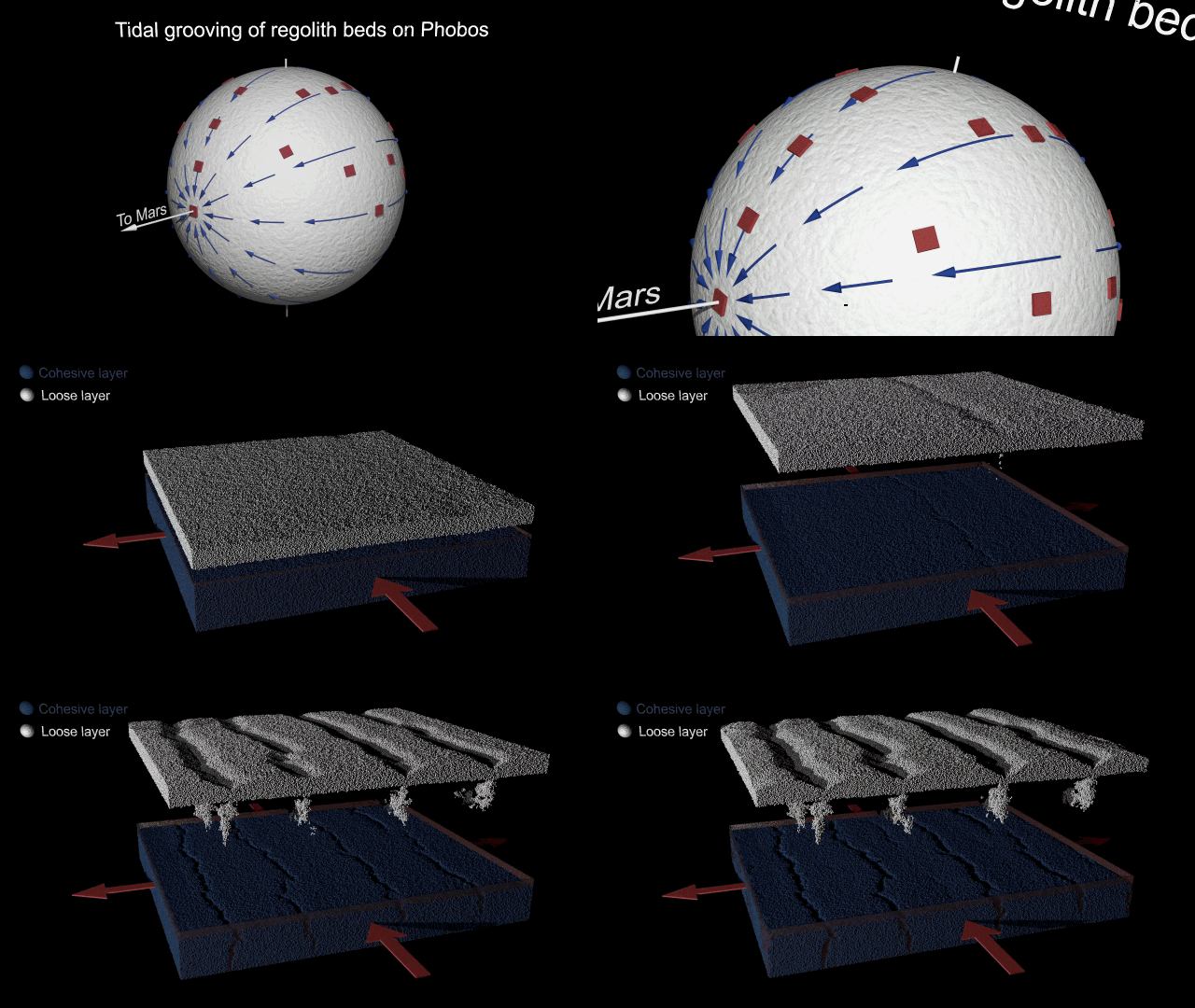
Here we simulate the extension of a mildly cohesive regolith shell, driven by Phobos’ tidal strain imposed by orbital migration, based on DEMBody. Modeling Phobos as a rubble-pile interior overlain by a cohesive layer similar to lunar soils, we find that the tidal strain creates parallel fissures with regular spacing, depending on the latitude and longitude, whose geometry and pattern are comparable to the grooves on Phobos. Fracture-opening triggers drainage of upper loose material into these deep-seated valleys, which we show could lead naturally to the formation of groove-like structures on Phobos. We map the prominent linear depressions on Phobos and find that most correlate with the model-predicted groove orientations. Our analysis supports a layered heterogeneous structure for Phobos with possible underlying failure-induced seismicity, as the precursor of the eventual demise of the de-orbiting satellite.
|
Related paper: Cheng, B., Asphaug, E., Ballouz, R. B., Yu, Y., & Baoyin, H. Tidal disruption as the origin of surface grooves on Martian moon Phobos. Under review.